
Not every home has a spare room for laundry, and not every balcony is big enough for a bulky drying rack that stays permanently set up. That’s exactly the gap a foldable cloth drying stand is built to fill — full drying capacity when you need it, and almost no footprint when you don’t.
If you’re renting, living in a compact apartment, or simply tired of a drying rack eating up hallway space, here’s what’s worth knowing before you pick one.
What Makes a Stand “Foldable”
A foldable cloth drying stand uses hinged joints — usually at the base and at each drying wing or tier — that let the entire frame collapse flat or into a compact bundle. Unlike a fixed floor stand, it isn’t built to stay assembled permanently; it’s designed to be set up for a drying session and then folded away afterward, often sliding neatly behind a door or into a storage corner.
This makes it fundamentally different from wall-mounted stands, which stay fixed in place — a foldable stand is meant to move with you.
Who Benefits Most From a Foldable Design
- Apartment dwellers with limited balcony or utility space
- Renters who don’t want to drill into walls for a wall-mounted stand
- Students and hostel residents who need something that packs away easily
- Anyone drying laundry indoors occasionally — during monsoon season, for instance, when a stand needs to move from balcony to living room and back
Even larger households often keep a foldable stand as a second unit for overflow drying, since it can be stored out of sight until it’s actually needed.
Common Folding Mechanisms
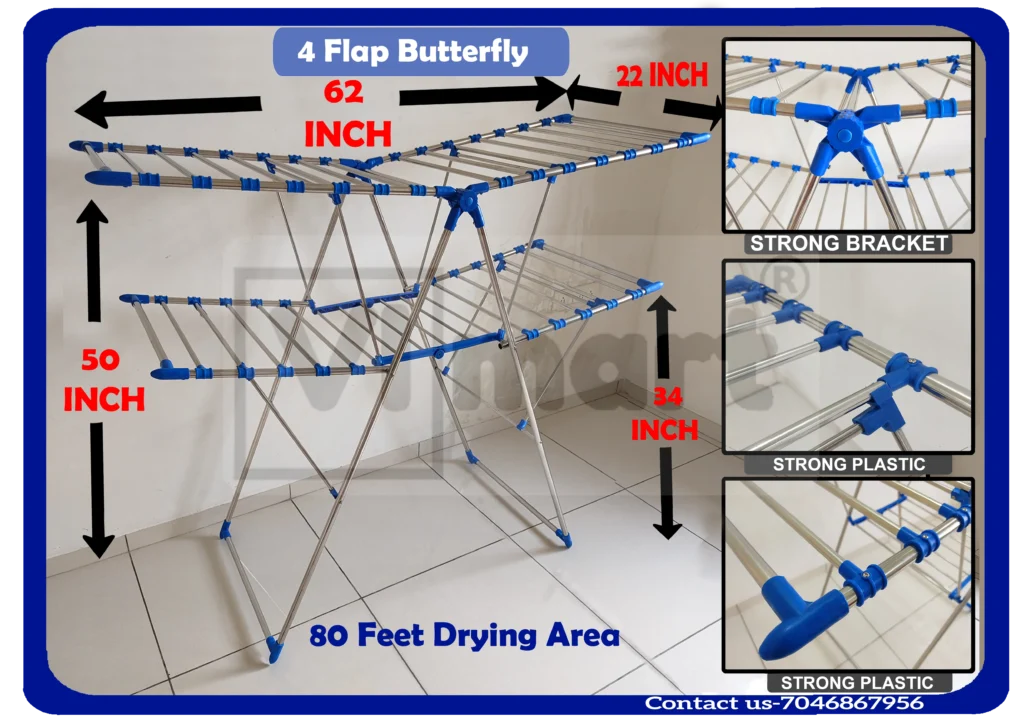
- X-frame (scissor-fold) stands — the most common design, where the frame collapses inward like a scissor lift. Quick to fold and unfold, and generally very stable once opened.
- Umbrella-style stands — wings radiate outward from a central pole and close inward, similar to an umbrella. These tend to have a smaller footprint when open, good for tight corners.
- Accordion / concertina stands — multiple tiers stack and fold in sequence, offering more hanging area for their folded size.
Each mechanism has trade-offs between how compact it folds and how much drying area it offers when open, so it’s worth checking both dimensions rather than just one.
What to Check Before Buying
Folded Size
If storage space is your main concern, check the folded dimensions specifically — not just the unfolded size. Some stands claim to be “compact” but still take up a surprising amount of space once collapsed.
Weight and Ease of Carrying
Since a foldable stand is meant to be moved, its weight matters more here than with a fixed floor stand. Aluminium-frame foldable stands are typically lighter and easier to carry one-handed, while stainless steel versions are heavier but often more rigid and durable.
Load Capacity and Stability When Open
A common complaint with cheaper foldable stands is wobbling once loaded with wet clothes. Look for a wide, stable base and check whether the stand locks firmly into its open position rather than relying on friction alone.
Number of Rods and Hooks
Because foldable stands are often smaller than permanent floor stands, pay attention to the actual rod and hook count relative to your laundry load — a stand with too few rods will leave you doing multiple drying rounds.
Build Material
Stainless steel handles humidity and repeated folding better than painted metal, which tends to chip at the hinge points over time and rust from the exposed edges. If the stand will live on a balcony rather than being stored indoors between uses, rust resistance matters even more.
Hinge Quality
Since the hinges are the first parts to wear out, check for reinforced or double-riveted joints rather than simple pinned hinges, especially if you’ll be folding and unfolding the stand daily.
Best Places to Use a Foldable Stand
- Small balconies — set up during the day, fold away in the evening if space is shared with other activities.
- Utility corners — tuck it beside a washing machine when not in use.
- Indoors during heavy rain — move it into a hallway or spare corner temporarily without permanently sacrificing floor space.
- Terraces in shared buildings — where a permanent fixture isn’t practical or allowed.
Getting the Most Life Out of Your Stand
- Fold and unfold gently rather than forcing hinges, which is the most common cause of early damage.
- Store it fully folded rather than half-open, since uneven stress on one hinge weakens it faster than the rest.
- Wipe down joints periodically, especially if it’s used outdoors, to prevent grit and detergent residue from stiffening the hinges.
- Avoid dragging it across rough flooring — lift and carry it instead to protect the base feet.
Choosing the Right One for You
A foldable cloth drying stand is less about compromising on capacity and more about matching your space and lifestyle — you get a full drying setup that simply isn’t in your way for the other 20 hours of the day it’s not being used.
Vimart’s foldable cloth drying stands are built with sturdy stainless steel frames and reinforced hinges specifically for the fold-and-store routine of Indian homes, so you’re not choosing between durability and convenience.